
Practical guide · Prague
Last updated: October 2026 · By the Traveler.sa Destinations Team · Reading time: 7 minutes
Many travelers hear about Prague, its bridges and its castle, and then ask the first question: where exactly is Prague, which country is it in, and is it close to Vienna and Munich? In this guide we cover the city's location on the map, the countries and cities around it, its weather, how to get there from Saudi Arabia, and what to prepare before you travel.
The short answer
Prague is the capital and largest city of the Czech Republic. It lies in Central Europe on the Vltava River in the region of Bohemia. The Czech Republic is a member of the European Union and the Schengen Area, and its currency is the Czech koruna, not the euro. Prague is just a few hours by train from Vienna, Berlin and Munich, which is why it is often combined with them in a single trip.
First
Where is Prague on the map?

Prague lies in Central Europe, in the western part of the Czech Republic, the historical region known as Bohemia. Running through its center is the Vltava River, which divides it into two banks connected by many bridges, the most famous being Charles Bridge.
The Czech Republic is a landlocked country bordered by four countries: Germany to the west, Poland to the north, Slovakia to the east and Austria to the south. This location is what makes Prague an easy stop on any road or rail trip between the cities of Central Europe.
The city is built on hills around the river, at an elevation of roughly 170 to 400 meters above sea level. Its historic center has been on the UNESCO World Heritage List since 1992.
Second
Quick facts about Prague
Prague in numbers
| Item | Details |
|---|---|
| Country | Czech Republic (capital) |
| Location | Central Europe, Bohemia region, on the Vltava River |
| Population | About 1.4 million |
| Area | About 496 km² |
| Currency | Czech koruna (CZK), not the euro |
| Language | Czech; English is widely spoken in tourist areas |
| Time zone | Central European Time |
| Airport | Václav Havel Airport Prague, west of the city |
Figures are approximate and subject to change.
The most important point for travelers in this table is the currency. The Czech Republic has been in the European Union since 2004 and in the Schengen Area since 2007, but it has not adopted the euro. Some tourist shops accept euros at an unfavorable exchange rate, so it is better to pay by card or in koruna.
Third
How far is Prague from nearby European cities?
Prague's proximity to the capitals of Central Europe makes it an excellent choice for multi-city trips. The following road distances are approximate:
Approximate distance between Prague and nearby cities
| City | Country | Approximate distance | Usually by train |
|---|---|---|---|
| Dresden | Germany | 150 km | About two and a half hours |
| Location on Google Maps | |||
| Vienna | Austria | 330 km | About 4 hours |
| Location on Google Maps | |||
| Berlin | Germany | 350 km | About 4 and a half hours |
| Location on Google Maps | |||
| Munich | Germany | 380 km | About 5 to 6 hours |
| Location on Google Maps | |||
| Budapest | Hungary | 530 km | About 7 hours |
| Location on Google Maps | |||
Travel times vary by train type and number of stops, so check the timetable before booking.
Because all these countries are in the Schengen Area, you can move between them on a single visa without the usual border procedures. One of the most popular routes is Prague, then Vienna, then Budapest. Read the Vienna shopping guide and 3-day itinerary and the7-day Poland itinerary if you are planning to extend your trip.
Fourth
How do you get to Prague from Saudi Arabia?
By air, you arrive at Václav Havel Airport Prague, the city's main airport, located to the west. Direct flights from the Kingdom may be available depending on the season and the airline; otherwise the trip involves one stop in cities such as Istanbul, Dubai or Doha, so compare options when booking.
From the airport to the city center there are public buses connecting to the metro, as well as taxis and ride-hailing apps. Within the city, the public transport network of three metro lines, trams and buses is easier than driving in the historic center.
If Prague is part of a wider trip, you can reach it by train from Vienna, Berlin or Munich, or by rental car. To drive, you need an International Driving License along with your Saudi license; also read tips for driving in Europe for the first time.
Fifth
Prague weather and the best time to visit
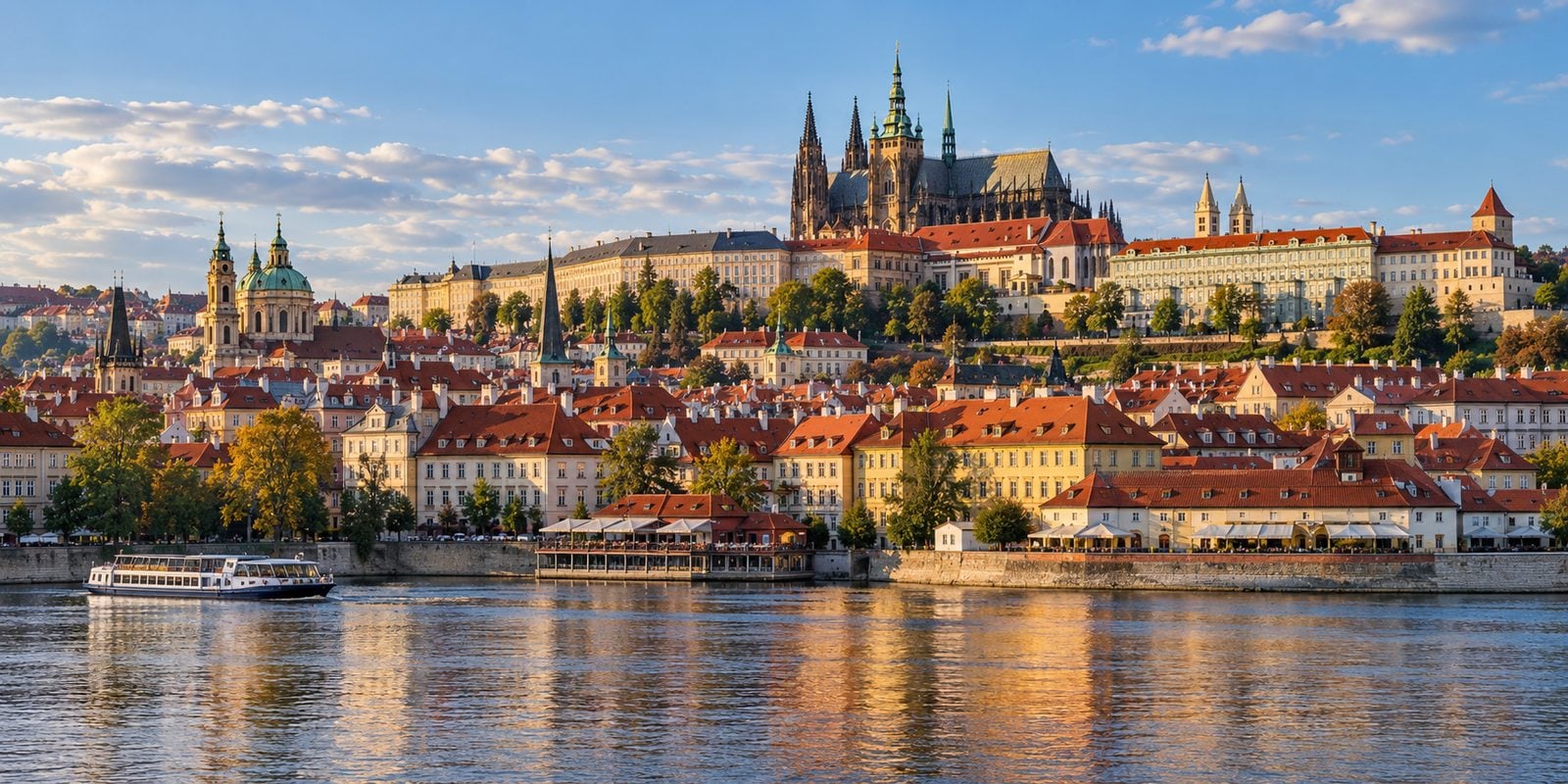
Prague Castle overlooks the city from the west bank of the Vltava River.
Prague has a moderate continental climate with four distinct seasons. Winter is cold, with January averaging around 2°C and a chance of snow, while summer is pleasant, with July averaging about 21 to 22°C.
Prague by season
| Season | Weather | Best for |
|---|---|---|
| Spring (April – May) | Mild and in bloom | Walkers and photographers |
| Summer (June – August) | Warm with long days | Families, with bigger crowds |
| Autumn (September – October) | Pleasant with golden colors | Those who prefer quiet |
| Winter (November – March) | Cold, with Christmas markets in December | Lovers of snow and lights |
Most travelers from the Gulf prefer late spring and early autumn: comfortable weather and fewer crowds than the summer peak. For details, read Spring in Europe: 5 destinations away from the crowds.
Sixth
What to see in Prague

Prague's Old Town Square: visit early in the morning, before crowds gather at the Astronomical Clock.
The main sights are close together, and most can be visited on foot:
- Prague Castle: a vast historic complex on the hill, home to St. Vitus Cathedral.
- Charles Bridge: a 14th-century stone bridge linking the Old Town with the Lesser Town.
- Old Town Square: home to the famous Astronomical Clock, dating back to the 15th century.
- The Vltava riverbanks: for walks, river cruises and sunset views.
For a ready day-by-day plan with places and costs, read the 4-day Prague itinerary, and for a day trip outside the city, read Český Krumlov from Prague.
Before you travel
What to prepare before traveling to Prague
- Visa: The Czech Republic is in the Schengen Area, and Saudi citizens usually apply for a Czech visa if it is their main destination. Requirements and processing times depend on the embassy, and the final decision rests with the embassy.
- Insurance: Approved medical insurance is a requirement for a Schengen visa.
- Internet: A Europe eSIM works from the moment you arrive.
- Currency: a bank card that works internationally and a small amount in koruna.
- Clothing: comfortable shoes, as the streets are cobbled, and layers for changeable weather.
Quick answers
Frequently asked questions
Prague is the capital of which country?
Prague is the capital and largest city of the Czech Republic, located in Central Europe on the Vltava River.
Is Prague in Germany or Austria?
No. Prague is in the Czech Republic, an independent country bordered by Germany, Austria, Poland and Slovakia.
What is Prague's currency? Is the euro used?
The currency is the Czech koruna. The Czech Republic is in the European Union but does not use the euro, so it is best to pay by card or in koruna.
Do Saudis need a visa for Prague?
The Czech Republic is in the Schengen Area, and Saudi citizens usually apply for a Schengen visa before traveling. Requirements depend on the embassy, and the final decision rests with the embassy.
How far is Prague from Vienna?
About 330 km, covered by direct trains in about four hours.
When is the best time to visit Prague?
Late spring (May) and early autumn (September) for mild weather and fewer crowds, and December for those who love the winter atmosphere.
Our services
Plan your trip with us
Official sources for further reading
Official Prague city website: basic information · Official Czech tourism authority · UNESCO: Historic Centre of Prague
Planning a trip to Prague?
We prepare your Czech visa file along with the required insurance and bookings. Contact us by phone or WhatsApp on our unified number.
Note: Entry and visa requirements may change, and the final decision on granting a visa rests with the embassy or the competent authority. The information in this article is up to date as of September 2026; always check with the official authority before traveling.