
Practical guide · Preparing for Europe
Last updated: September 2026 · By the Traveler.sa Destinations Team · Reading time: 9 minutes
There are things you should know before traveling to Europe, a diverse continent where what applies in one country may not apply in its neighbor: the currency changes, plugs differ, shop hours have their own customs, and since April 2026 the border procedures themselves have changed. This is an organized checklist, with tables, of the most important things to know and prepare before you travel, complementing our guide tips before traveling to Europe for the first time.
The short answer
Prepare your Schengen visa, insurance and bookings early, and make sure your passport is valid for at least 3 months after your departure date from Europe. Be ready to register your fingerprints and facial image in the EES at first entry, know each country's currency (the euro in 21 European countries), buy an eSIM before you travel, carry a power adapter, and save the emergency number 112.
First
Travel documents for Europe: the foundation of the trip
Before booking any activities or restaurants, start with the documents, as they take the longest and have the biggest impact on your travel date. A visa file usually needs several documents and a biometrics appointment, and appointments get busy in peak seasons.
Essential documents before traveling to Europe
| Document | What to check |
|---|---|
| Passport | Valid for at least 3 months after your departure from Europe, and issued within the last 10 years. |
| Schengen visa | Covers the entire trip, issued by the embassy of the country where you will spend the longest time. |
| Medical insurance | Approved and covering the full duration and all Schengen countries, as embassies usually require. |
| Bookings | Flights and accommodation matching the itinerary in your visa file. |
| International Driving License | If you will drive, alongside your Saudi license. |
| Digital copies | Passport, visa and bookings on your phone and in your email. |
Passport validity requirement according to the official Your Europe portal; some embassies may require longer, so check their requirements.

New in 2026
The European Entry/Exit System (EES) in 2026
Since 10 April 2026 the European Entry/Exit System (EES) has been fully operational in the Schengen countries, after a gradual start in October 2025. The system records the entry and exit of travelers from outside the EU digitally instead of stamping passports, and this includes Saudi Schengen visa holders.
- At first entry, your fingerprints, facial image and passport details are recorded, so expect a longer wait at passport control.
- On later visits, procedures are usually faster because your data is already registered.
- The system counts your days of stay automatically, so stick to the 90 days in any 180 days rule and the duration of your visa.
- Keep your hotel booking, return ticket and proof of insurance, as they may be requested on arrival.
For official details, see the official European travel portal.
Third
Currencies and payments in Europe

The euro is the official currency in 21 EU countries, but a number of Schengen countries still use their own currency. If your program passes through more than one country, check the currency of each stop before you arrive.
Cards are widely accepted in shops, restaurants and on public transport, but keep a small amount of cash for small shops or traditional markets. When paying by card in a country that does not use the euro, it is usually best to pay in the local currency to avoid the high conversion margins some terminals may add.
Schengen countries that don't use the euro
| Country | Currency |
|---|---|
| Switzerland and Liechtenstein | Swiss franc (CHF) |
| Czech Republic | Czech koruna (CZK) |
| Hungary | Forint (HUF) |
| Poland | Zloty (PLN) |
| Romania | Romanian leu (RON) |
| Denmark | Danish krone (DKK) |
| Sweden | Swedish krona (SEK) |
| Norway | Norwegian krone (NOK) |
| Iceland | Icelandic krona (ISK) |
The rest of the Schengen countries use the euro, including Bulgaria, which joined the eurozone in 2026.
Fourth
Flying to Europe and getting between its cities

Trains are the best way between major cities; book high-speed routes early.
Flight times from Riyadh and Jeddah to major European cities
| City | From Riyadh | From Jeddah |
|---|---|---|
| Milan | About 6 hours direct | About 5–5.5 hours direct |
| Frankfurt or Munich | About 5.5–6.5 hours direct | About 5.5–6 hours direct |
| Zurich or Geneva | About 6 hours direct | About 5.5–6 hours direct to Geneva; Zurich with a stop |
| Paris | About 6.5 hours direct | About 6 hours direct |
| London | About 7 hours direct | About 6.5–7 hours direct |
| Amsterdam | 8–11 hours with one stop | About 6.5 hours direct |
Flight times are approximate and vary by departure city, airline and stopover, and some direct routes are seasonal; a one-stop flight usually adds 2–4 hours.
Within Europe, trains are the best option between nearby cities (such as Paris and Amsterdam or Rome and Milan in 3–4 hours), with the metro, trams and buses within cities. Daily or multi-day transport passes save money compared with buying a ticket for each ride.
- Book high-speed train tickets early if your date is fixed.
- Validate or stamp your ticket before boarding in cities that require it, as inspections are common and fines are on the spot.
- Download the city's official transport app for timetables and routes.
- If you will drive, read tips for driving in Europe for the first time.
Fifth
Internet and electricity in Europe
An eSIM for Europe covers dozens of countries with one plan, so you cross borders without changing SIMs. Activate it before takeoff or right after landing so you have internet for maps and transport apps from the moment you arrive.
As for electricity, the voltage is about 230 volts in most countries, and plugs are not standardized:
| Plug | Where you'll find it |
|---|---|
| Two round pins (C and F) | Most of continental Europe, such as Germany, France, Spain and Austria. |
| Type J with three pins | Switzerland, which usually also accepts the slim two-pin plug. |
| Type L | Italy, alongside types C and F. |
| Type G (like Saudi Arabia) | The United Kingdom, Ireland, Malta and Cyprus. |
The easiest solution is a universal adapter that covers all types.
Sixth
Tipping, opening hours and tax refunds in Europe
Tipping
Tipping varies from country to country; in many restaurants service is included in the bill or a token amount is left. Check the bill before paying to see whether service is included.
Opening hours
Many shops close on Sunday, and some close at midday in southern Europe. Plan your shopping and visits accordingly, leave Sunday for parks and open attractions, and check museum hours, as some close on a fixed day each week.
Tax refunds on purchases
Travelers from outside the EU may be able to reclaim VAT on their purchases according to each country's rules. The process starts at the store and usually ends at the airport before departure.
- Ask the store for the tax refund form when you buy.
- Keep receipts and purchases unused until departure.
- Allow extra time at the airport to complete the process before or after checking in your luggage, according to the airport's instructions.
Seventh
Personal safety in European cities
Watch your belongings at train stations and crowded tourist spots, and save the unified European emergency number 112.
- Use a bag with a front zip in crowds, and don't keep your wallet in your back pocket.
- Keep a copy of your passport separate from the original to make procedures easier if it is lost.
- Spread your cash and cards across more than one place.
- Don't leave your phone on a cafe table in open areas.
To know what to do if you lose your passport or luggage, see the most common travel problems and how to avoid them.
Budget
How much does a one-week trip to Europe cost in summer?
Knowing your budget before applying for the visa is important, because the bank statement in your file should cover the cost of the trip. These are estimates for a full week at summer prices, including flights, accommodation, food, transport and attractions, taken from our detailed guides for each destination:
Approximate cost of a 7-day trip in summer (in riyals)
| Destination and duration | Young travelers (per person) | Couple (for two) |
|---|---|---|
| Poland, 7 days | 5,350–9,600 | 10,750–19,200 |
| Vienna and Prague, 7 days | 6,200–12,150 | 12,600–24,100 |
| Italy (Rome, Venice and Milan), 7 days | 7,250–13,200 | 14,400–26,300 |
| The Netherlands, 7 days | 7,550–14,500 | 13,800–26,000 |
Estimated figures for the summer (peak) season as of September 2026; young travelers are per person in shared accommodation, couples are for two in a private double room. They vary by departure city, booking date and type of accommodation. Shopping is not included; visa fees and insurance are roughly included under miscellaneous.
Flights and accommodation make up more than half the budget in summer. To save: book flights early or travel in June or September, stay near a main train station instead of the historic center, and use weekly transport passes. Full details for each destination are in tips before traveling to Europe for the first time.
Timeline
When should you prepare everything before traveling to Europe?
Spreading tasks over stages eases the pressure of the final days. Here is a suggested order you can adjust to your travel date:
| Stage | Tasks |
|---|---|
| Well before travel | Set the program and duration, prepare the visa file with a temporary booking and medical insurance, and book your biometrics appointment early, before holiday seasons. |
| After the visa is issued | Confirm flights and hotels, and book high-speed trains and attractions that require advance tickets. |
| Two weeks before travel | Get your International Driving License if you will drive, and check that your bank cards are valid. |
| The final week | Buy an eSIM, pack a power adapter and download offline maps. |
| Travel day | Passport, visa and copies of bookings in your hand luggage, and extra time for EES procedures. |
Tenth
European weather and what to wear
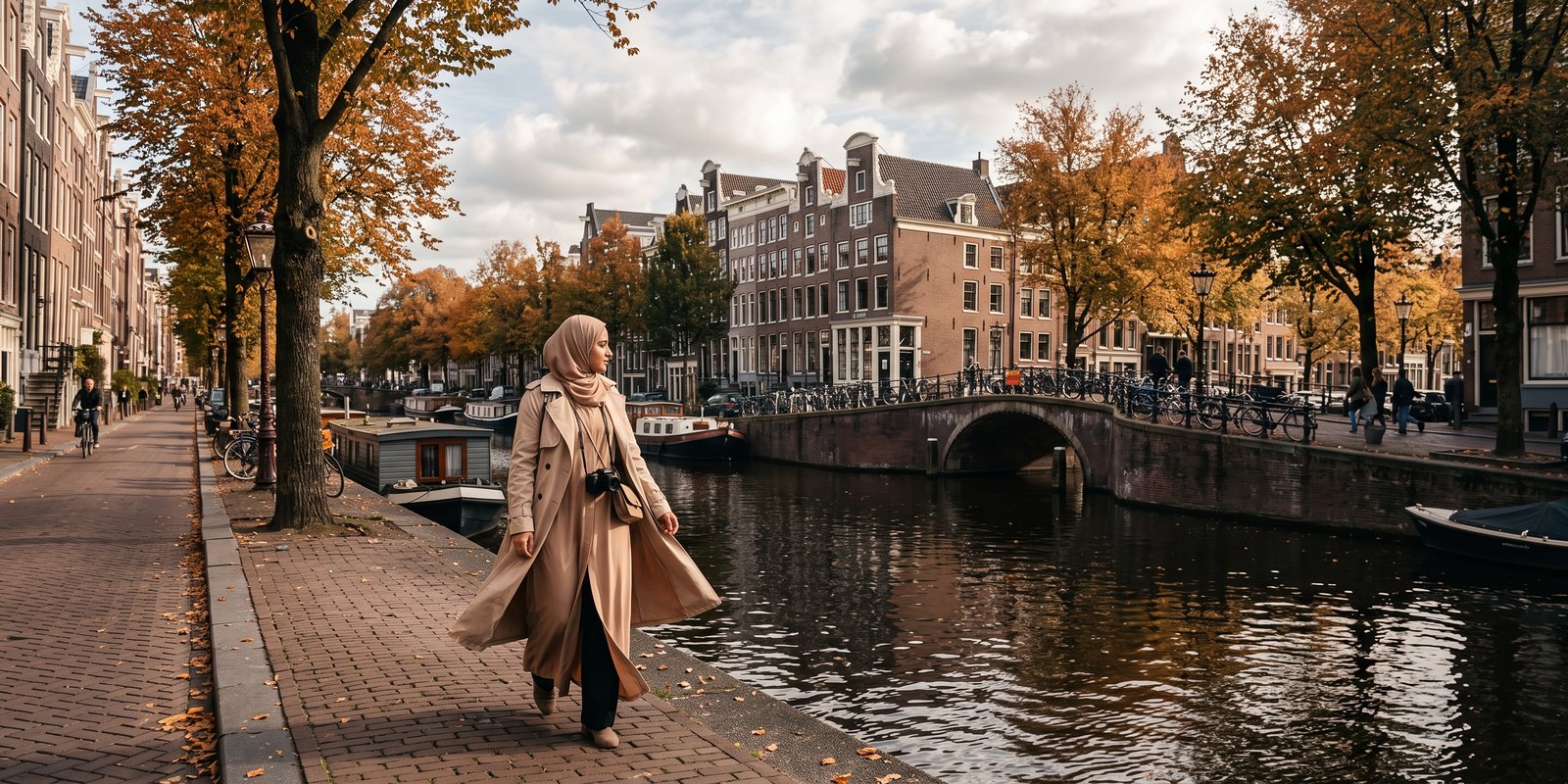
Amsterdam in autumn: weather shifts fast, so wear light layers and carry a small umbrella.
The weather in Europe varies a lot between north and south, and between coastal and mountain cities, even in the same month. Check the forecast for each city in your program a few days before packing.
- Layered clothing that is easy to take off and put on, as mornings and evenings are usually cooler than midday.
- Comfortable walking shoes, as most tours of old towns are on foot over stone pavements.
- A small umbrella or a rain jacket, especially in northern countries.
Before you travel
Quick Europe packing checklist
Review this list a week before your trip:
- Passport and visa, with digital copies of both.
- Insurance document and the insurer's emergency number.
- Hotel and train bookings printed or saved offline.
- At least two bank cards and a small amount of cash in the first country's currency.
- A universal power adapter and a power bank.
- eSIM activated or ready to activate.
- Clothes suited to the weather of each city in your program.
If you are still choosing your destination, read our Europe travel guide, and for a limited budget, the cheapest European countries for tourism.
Quick answers
Frequently asked questions
What is the most important thing to know before traveling to Europe?
That the visa, insurance and passport validity come first, that entry now involves registering fingerprints and a facial image in the EES, and then the currency, plugs and internet for each country.
How long should my passport be valid to travel to Europe?
At least 3 months after your departure date from the Schengen area, and issued within the last 10 years; some embassies may require longer.
Do Saudis need a visa to travel to Europe?
Yes, for Schengen countries you need a prior Schengen visa from the embassy of the country where you will spend the longest time, and the decision rests with the embassy. Some non-Schengen countries have different rules, such as Montenegro and Albania with temporary exemptions, so check with each country's official authority.
How much does a trip to Europe from Saudi Arabia cost?
A week in summer including flights costs roughly 5,350 to 9,600 per young traveler in Poland, and 7,250 to 14,500 in Italy or the Netherlands. For a couple, 10,750 to 19,200 in Poland, and 13,800 to 26,300 in Italy or the Netherlands. Details are in our guide to the cheapest European countries for tourism.
Do I need a power adapter in Europe?
Yes, most countries use two-round-pin plugs that differ from Saudi Arabia's, Switzerland and Italy have additional types, and a universal adapter is the easiest solution.
How long is the flight from Saudi Arabia to Europe?
About 5–6 hours direct from Riyadh or Jeddah to Milan, Frankfurt and Munich, about 6–7 hours to Paris and London, and about 6.5 hours from Jeddah to Amsterdam (from Riyadh with a stop); a one-stop flight usually adds 2–4 hours.
Our services
Prepare your trip with us
Official sources for further reading
European Commission: Schengen and visas · Official European travel portal · Your Europe portal: travel documents for non-EU nationals
Getting ready for Europe?
We handle your Schengen visa file, temporary booking, insurance and internet SIM. Contact us by phone or WhatsApp on our unified number.
Note: entry requirements and visas may change, and the final decision on granting a visa rests with the embassy or competent authority. The information in this article is up to date as of September 2026, and it is always advisable to check with the official authority before traveling.